
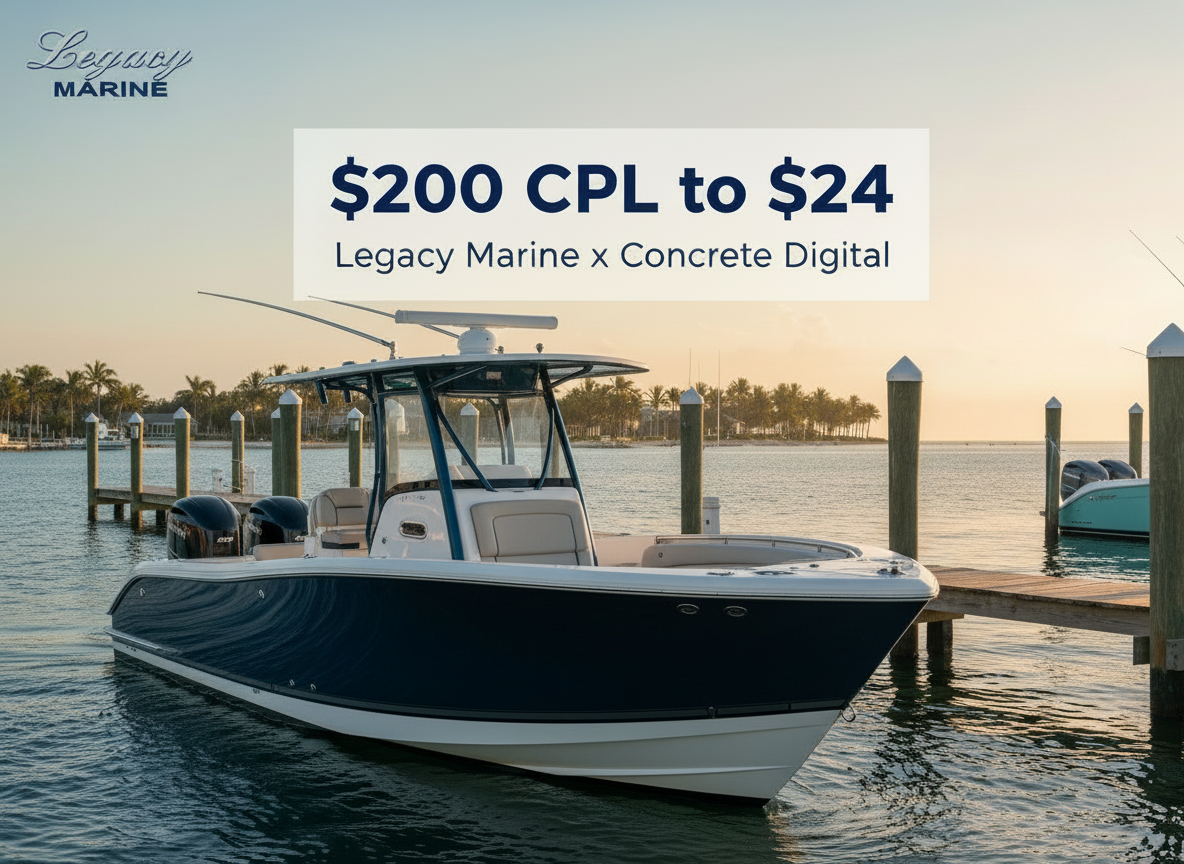
How Legacy Marine Went From $200 CPL to $24 Using Google and Meta Ads — A Boat Dealer Case Study
The Client: Legacy Marine — Stuart & Fort Lauderdale, FL
Legacy Marine is a premier boat dealership serving Southeast Florida with two locations: Stuart on the Treasure Coast and Fort Lauderdale on the Gold Coast. Their inventory spans premium offshore and inshore brands — Tidewater, Front Runner, Chris-Craft, Shallow Sport, and SCB — with boats ranging from $80,000 to $250,000+. High-end center consoles, luxury day boats, and serious sportfishing rigs. The kind of inventory where one sale can justify an entire month of marketing spend.
They’ve been running paid digital advertising with me for six years, making them my longest-running client in the marine space. When the relationship started, Legacy Marine was doing what virtually every independent boat dealer in the country was doing: paying a massive third-party listing platform a five-figure monthly fee just to exist online, generating leads they didn’t own, and building equity in someone else’s brand.
What followed was six years of testing, iteration, platform diversification, audience refinement, and gradual optimization — a process that took a dealership paying $200 per lead on borrowed traffic and turned it into a multi-platform lead machine generating qualified buyers at $24 per tracked conversion directly to their own website.
This is what that process actually looked like.
The Problem: $15,000/Month for Leads You Don’t Own
Before working together, Legacy Marine’s entire digital strategy depended on a single third-party boat listing platform. On the surface, it made sense — these platforms aggregated massive buyer audiences and gave dealers inventory visibility they couldn’t build on their own. In practice, the economics were brutal.
At peak spend, Legacy Marine was paying $15,000+ per month to list their inventory. In March — prime pre-season for Florida boat buyers — that spend was producing fewer than 10 qualified leads. That’s a cost per lead approaching $200, for buyers who had zero direct brand relationship with Legacy Marine. The leads lived in the platform’s CRM, not Legacy Marine’s. The audience data belonged to the platform. Every dollar spent was making the listing platform stronger, not the dealership.
The structural problem was even worse than the CPL: there was no retargeting audience being built, no pixel data accumulating on Legacy Marine’s own site, no foundation for any kind of owned digital strategy. If they ever stopped paying, they’d have nothing — no audience, no data, no brand equity online. Just a blank slate and a $15K/month habit to break.
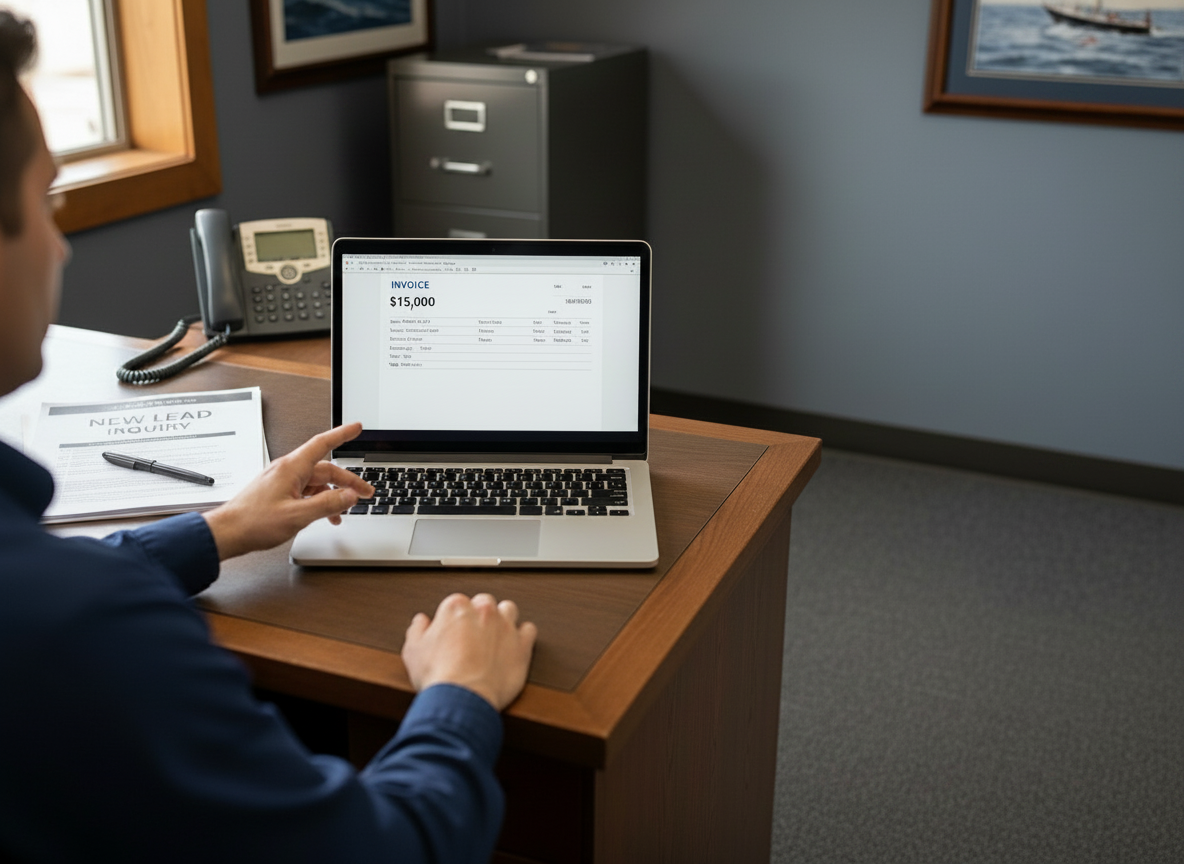
They were paying to appear on someone else’s platform, generating leads that went into someone else’s database, building an audience that belonged to someone else entirely. The whole thing reset to zero the moment the invoice stopped.
— The core problem with third-party listing dependencyThe Strategy: Build Something You Own
The pitch was straightforward: take a fraction of that listing platform spend and redirect it toward campaigns that drove boat buyers directly to Legacy Marine’s own website. Every click would build their pixel audience. Every visit would feed retargeting pools. Every lead would land in their inbox, not a third-party CRM.
The platforms were Google Ads, Meta (Facebook and Instagram), Google Shopping, and Bing — eventually running simultaneously as a closed-loop ecosystem where each channel fed the others. But getting there took real work. What follows is an honest account of how we built it, including what didn’t work before we found what did.
The Testing Process: How We Arrived at $24 CPL
Nobody builds a $24 CPL on a $250,000 boat inventory on the first try. This is the actual progression — campaign by campaign, hypothesis by hypothesis — that got us there.
Catalog Sales — All Products (Broad Audience, Traffic Focus)
The foundation was a Meta catalog sales campaign running against the full inventory feed — every boat, every brand, dynamically served to a broad South Florida audience. The goal at this stage wasn’t conversions. It was data. We needed to build a pixel audience from scratch, understand which inventory generated the most engagement, and identify what a Legacy Marine buyer looked like on Facebook and Instagram before we could optimize toward them.
This campaign ran across 1.4 million impressions and drove over 84,000 clicks at $0.039 per click — some of the cheapest qualified marine traffic we’ve seen. Sixty-nine thousand of those clicks turned into landing page views, seeding the retargeting audiences that every subsequent phase would rely on. No purchase conversions tracked at this stage, and none expected. This was laying pipe.
Brand-Specific Retargeting — Avalon & Chris-Craft (180-Day Windows)
With audiences built, we moved into brand-specific retargeting. Separate ad sets for Avalon and Chris-Craft targeting users who had engaged with Legacy Marine’s content or visited their site within the past 180 days. The logic: boat buyers at this price point take weeks to decide. A 180-day window keeps the brand visible across the entire consideration cycle — not just the last 7 days before a purchase.
The Chris-Craft campaign ran two parallel ad sets: a standard 180-day retargeting pool and a lookalike audience built from that same pool. Both showed strong engagement but the CPL was still high relative to our eventual target — the conversion event we were optimizing toward wasn’t tight enough yet, and the algorithm didn’t have a clear signal for what a real purchase intent looked like.
Key learning here: the conversion event you optimize toward determines the quality of who Meta finds for you. Optimizing toward traffic gets you traffic. Optimizing toward purchases gets you buyers. We weren’t fully there yet.
Lead Campaigns — Catalog + Advantage+ Audiences (Finding the Signal)
We tested a dedicated lead generation campaign using Meta’s Advantage+ audience targeting against the full product catalog. The hypothesis: let Meta’s algorithm find buyers across a broader audience rather than restricting to our manually-built retargeting pools.
The results were mixed in the right way. CPCs were higher ($0.159 average) and add-to-cart activity was picking up — 56 add-to-cart events — but we still weren’t feeding Meta a strong enough purchase signal to really let the algorithm loose. The campaign was generating engagement but the conversion funnel wasn’t tight.
This phase taught us two things: first, Advantage+ audiences were worth pursuing but needed a better optimization event. Second, the catalog feed itself was doing real work — dynamically showing buyers the specific boats they’d already viewed was generating meaningful re-engagement. The retargeting infrastructure built in Phase 1 was paying dividends.
CatalogSales NEW — Purchase Optimization + HHI Targeting Layer
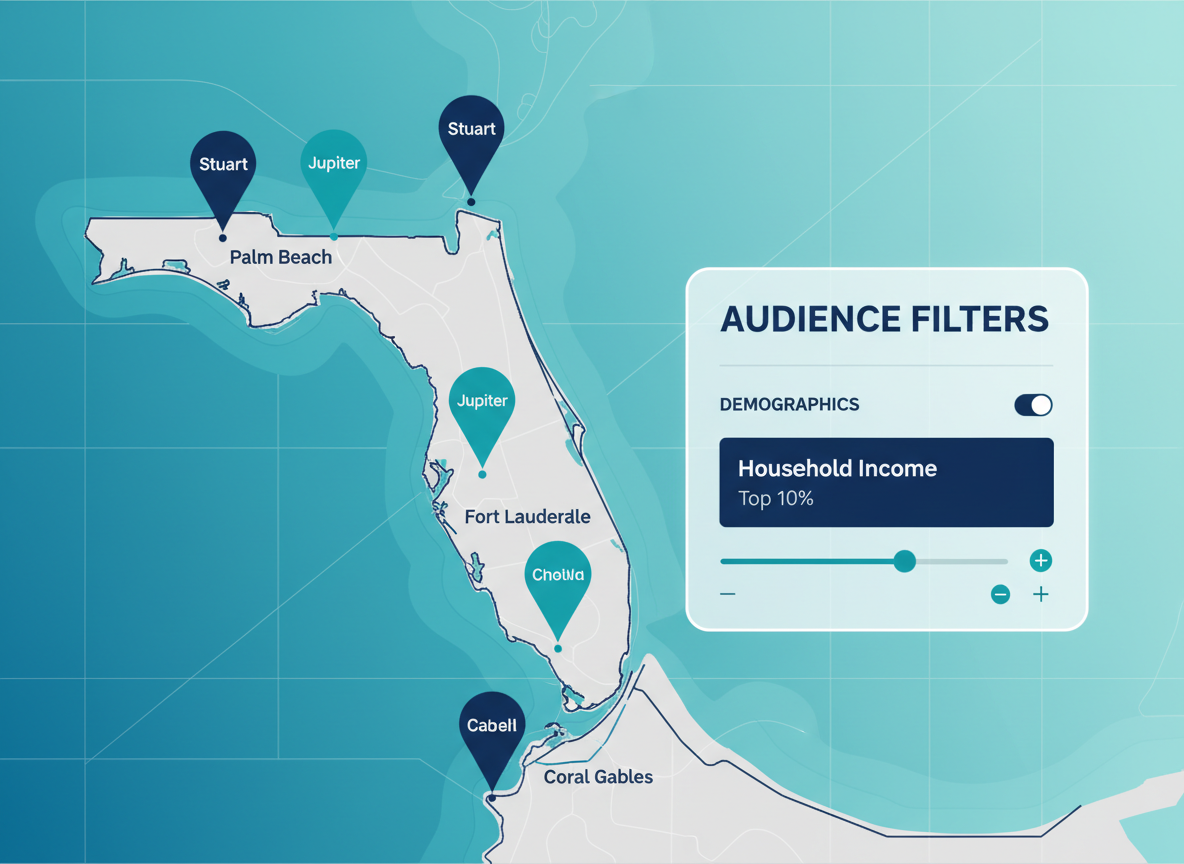
This is where the strategy shifted in a meaningful way. We rebuilt the catalog campaign from scratch with two critical changes: first, we switched the optimization event from traffic/engagement to purchase, giving Meta a clear signal for what success looked like. Second, we added a household income targeting layer — top 10% HHI zip codes across the South Florida coastal corridor.
The HHI layer was a deliberate bet. Legacy Marine sells $80,000–$250,000 boats. Casting a wide net across all Florida demographics means a significant percentage of your audience simply cannot afford what you’re selling. By tightening to top-decile income zip codes — Coral Gables, Palm Beach, Jupiter, Dania Beach, Stuart — we reduced audience size but dramatically improved buyer quality. The surprising result: CPL dropped and quality improved simultaneously. Smaller pool, better signal, more efficient algorithm.
CTR jumped to 15.58% on this campaign — a strong indicator that the right people were seeing the right inventory. CPC settled at $0.057, and the campaign started recording tracked purchase events for the first time.
CatalogSales v2 — Max Purchase Optimization (The Unlock)
With purchase signal now flowing into Meta’s algorithm from Phase 4, we launched a second campaign variant optimized specifically toward maximum purchase volume — letting Meta’s bidding system prioritize finding buyers over minimizing cost per click. This is the campaign that broke through.
43 tracked purchases. $24.13 cost per tracked conversion. Against a boat inventory averaging $80,000–$250,000 and a close rate of 11.65%, the math becomes almost absurd: at $24 per conversion event, a single closed sale generates an ROI that pays for months of the entire program.
The key unlock was the accumulated purchase data from Phase 4 feeding the algorithm. Meta needed examples of what a Legacy Marine buyer looked like — their browsing patterns, their demographics, their behavior — before it could go find more of them efficiently. Phase 4 built that foundation. Phase 5 deployed it at scale.
The Targeting Insight That Changed Everything: Household Income Layering
Of all the optimizations across six years, the household income targeting layer on Meta deserves its own explanation — because it runs counter to what most marketers instinctively do.
Conventional paid media thinking says: bigger audience = more opportunity. More reach means more chances to find buyers. For most products, that logic holds. For a $150,000 boat, it doesn’t.
When you’re selling a product that requires a $150,000–$250,000 discretionary purchase, a large percentage of any broad audience is statistically ineligible — not disinterested, just unable. Every impression served to someone who can’t buy is a wasted impression. Every click from someone who can’t qualify for marine financing is a wasted click. The algorithm learns from these interactions and starts finding more of the same people.
By targeting zip codes in the top 10% household income bracket across South Florida’s coastal markets — areas where $200,000 boats are a realistic discretionary purchase — we did something counterintuitive: we made the audience smaller and the results better at the same time. Meta’s algorithm had a tighter, higher-quality pool to learn from. The feedback loop tightened. CPL dropped. Lead quality climbed.
The principle: For high-ticket inventory, audience quality matters more than audience size. A 500,000-person audience of boat-eligible buyers outperforms a 5,000,000-person audience of general Florida residents every time — because the algorithm learns faster, wastes less, and finds the right people more efficiently.
The Sale That Proved the System: A $250,000 Chris-Craft From a Cold Meta Prospect
For most of the first phases, Legacy Marine was cautiously optimistic about Meta. The traffic numbers were strong, the CPCs were encouraging, and the retargeting audiences were growing — but there was no single, undeniable moment of proof. Then the Chris-Craft sold.
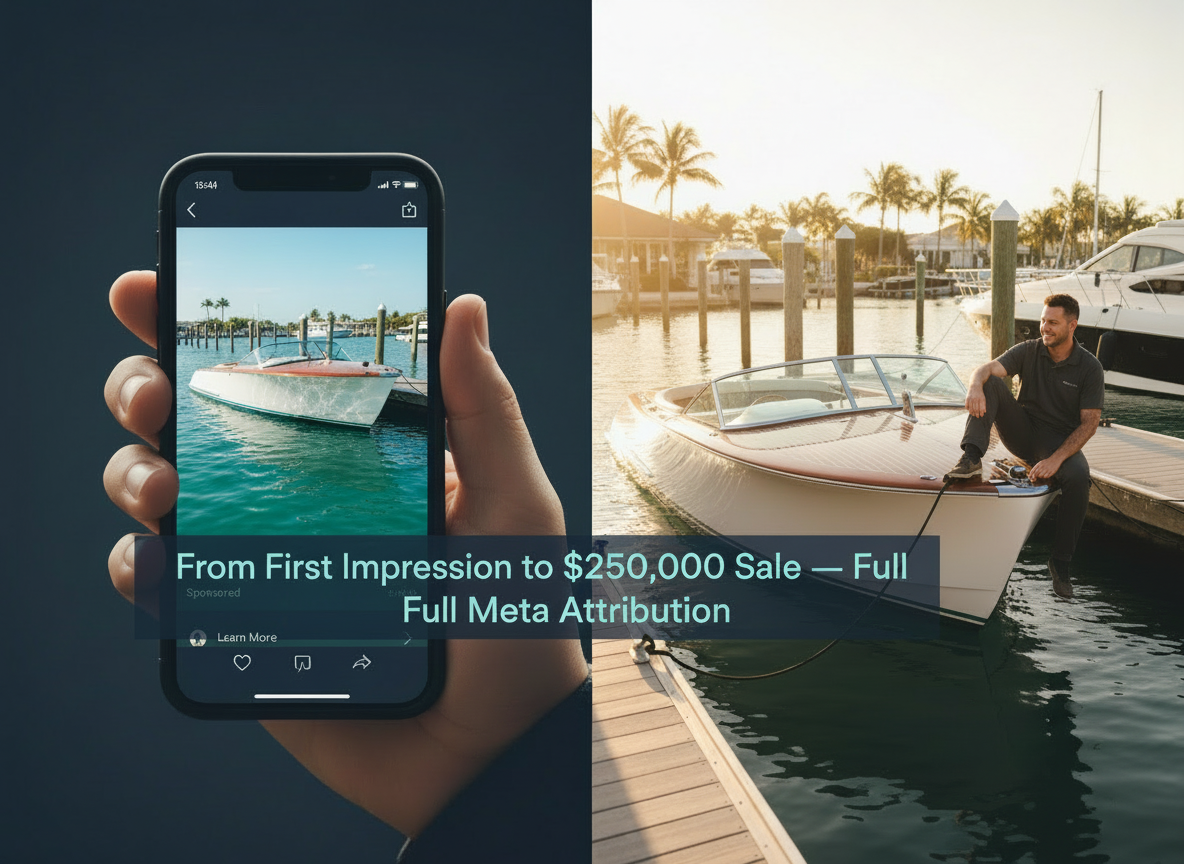
A prospect entered the top-of-funnel catalog campaign cold — no prior relationship with Legacy Marine, just a South Florida resident in a high-HHI zip code who saw a Chris-Craft in his feed, clicked, browsed, and left. The retargeting sequence picked him up. Over the next two weeks he was shown specific boat content across Facebook and Instagram, each ad pulling him slightly further down the funnel. He came back to the site. He booked a test drive. He came back a third time and put down a deposit.
A $250,000 Chris-Craft, closed through Meta. Full attribution, beginning to end. No listing platform involved. No third-party referral. A paid campaign that Legacy Marine owned, generating a sale that paid for months of the entire program.
That sale changed the internal conversation at Legacy Marine from “this is interesting” to “we need to scale this.” Budget went up. The v2 purchase campaign launched. And the six-year relationship that started as a hedge against owned-channel strategy became the core of their digital strategy.
One cold prospect. Two weeks of retargeting. One $250,000 boat sold. The entire attribution chain lived inside campaigns we built and owned — not inside a platform’s ecosystem that resets every time the invoice is late.
— The Legacy Marine Chris-Craft saleThe Results: Six Years of Live Account Data
The following numbers are sourced directly from Legacy Marine’s Meta Ads account via live reporting. They reflect the full progression from early-phase testing through the optimized campaigns running today.
| Metric | Before Concrete Digital | After Concrete Digital |
|---|---|---|
| Monthly Platform Spend | $15,000+ (listing platform) | $5,000–$10,000 (owned channels) |
| Cost Per Lead / Conversion | ~$200 | $24.13 (purchase-optimized) |
| Lead Data Ownership | Platform owns all data | Legacy Marine owns 100% |
| Retargeting Audiences | None | Full cross-platform pools |
| Meta Cost Per Click | N/A | $0.039–$0.057 (live data) |
| Meta CTR (optimized campaigns) | N/A | 10.3%–15.6% |
| Active Advertising Platforms | 1 (listing site) | 4 (Google, Meta, Shopping, Bing) |
| Tracked Purchase Conversions | 0 | 48 (last campaign cycle) |
| Largest Attributed Sale | — | $250,000 Chris-Craft via Meta |
The ROI Math for Boat Dealers
Legacy Marine’s average boat sale runs $80,000–$250,000. Their close rate on qualified leads is approximately 11.65%. At $24 per tracked conversion and a $2,500/month management retainer, the math works like this: close one boat sale from any given month’s leads and the entire program — ad spend plus management fees — is paid back. Every additional lead after that is pure margin.
One $80,000 boat sale at 11.65% close rate requires roughly 9 qualified leads. At $24 CPL, that’s $216 in ad spend to generate the leads that close a $80,000 transaction. The listing platform was charging $15,000/month for fewer than 10 leads in peak season. That’s the comparison every boat dealer should be running.
Why This Works for Boat Dealers Specifically
The marine retail industry has structural characteristics that make owned digital advertising unusually powerful — and that make third-party listing dependency unusually costly.
Boat buyers spend an average of three to five weeks researching before making first contact with a dealer. That research happens across Google search, YouTube, Facebook, Instagram, and manufacturer websites. A buyer who starts on a listing platform and clicks through to Legacy Marine’s website is now in Legacy Marine’s ecosystem — cookied, pixeled, eligible for retargeting. A buyer who stays inside the listing platform’s ecosystem generates data that belongs to the platform forever.
The implication: every dollar spent driving traffic to your own website builds a compounding asset. Your retargeting pools grow. Your lookalike audiences improve. The algorithm gets smarter about who your actual buyers are. None of this happens when your inventory lives on someone else’s domain.
Additionally, Meta’s catalog integration allows boat dealers to run dynamic inventory ads — showing individual listings to users who’ve already viewed that specific model, make, or price range. A user who spent 4 minutes on the 2025 Tidewater 252 CC Adventure page can be retargeted with that exact listing across Facebook, Instagram, and Meta’s partner network. The listing platform can’t do that for your brand. Only you can.
What Every Independent Boat Dealer Can Take From This
- Start with traffic before you optimize for conversions. You can’t ask Meta’s algorithm to find buyers if it doesn’t have examples of what your buyers look like. Phase 1 traffic campaigns are an investment in the data quality of every campaign that follows.
- The optimization event is everything. Optimizing toward traffic gets you traffic. Optimizing toward purchases — once you have enough signal — gets you buyers. The switch from engagement optimization to purchase optimization was the single biggest CPL lever we pulled.
- HHI targeting is underused in the marine space. If you’re selling $80,000–$250,000 boats to a broad audience, you’re burning budget on people who can’t buy. Top-decile income zip codes cost you reach and improve virtually every performance metric simultaneously.
- Brand-specific ad sets outperform generic inventory campaigns for high-consideration buyers. A buyer researching Chris-Craft responds differently to a Chris-Craft-specific ad than a generic “boats for sale” ad. Segment your campaigns by brand when inventory and budget allow.
- The 180-day retargeting window matches how boat buyers actually decide. This isn’t a 7-day purchase cycle. Stay visible across the full consideration window — not just the last week before someone visits your lot.
- One closed deal justifies the entire program. At $80,000+ average transaction value and an 11.65% close rate, the ROI math on owned digital advertising is overwhelming. The question isn’t whether you can afford to run these campaigns. It’s whether you can afford not to.
Boat Dealer Digital Marketing: Frequently Asked Questions
Based on live account data from campaigns running in the South Florida market, a well-optimized Meta purchase campaign can deliver tracked conversions at $21–$24 per lead for dealerships selling boats in the $80,000–$250,000 range. Industry benchmarks for national third-party listing platforms run $150–$200+ per lead in the same market. The gap between owned-channel CPL and listing-platform CPL widens as campaigns mature and purchase signal accumulates in the algorithm.
Yes — with the right structure. The key variables are campaign objective (purchase optimization outperforms traffic optimization for conversion quality), audience targeting (household income layers significantly improve lead quality for premium inventory), and funnel architecture (top-of-funnel catalog traffic → brand-specific retargeting → purchase-optimized conversion campaigns). Generic “boost post” approaches rarely work at the $80,000+ inventory level. Purpose-built campaign architecture does.
Both, and they serve different roles. Google Search captures active intent — buyers who are already searching “Tidewater 252 for sale Florida” are ready to talk to a dealer today. Meta captures passive demand — buyers who haven’t started searching yet but match the demographic and behavioral profile of someone who will. The combination creates a full-funnel system where Google closes near-term buyers and Meta builds the pipeline of future ones. Running only one platform means leaving half the funnel unworked.
Marine industry data consistently shows boat buyers at the $50,000+ price point spend three to five weeks researching before making first dealer contact. This is why 180-day retargeting windows matter, and why consistent top-of-funnel presence on Meta is more valuable than short-burst campaigns. The buyer who sees your inventory in January may not visit your dealership until March — but if you stayed visible the whole time, you’re the first call he makes.
The competitive advantage of owned digital advertising over listing platforms is cumulative data ownership. Every click to your website builds your pixel audience. Every form fill goes into your CRM. Every retargeting pool grows with each campaign you run. Listing platforms start at zero every month — you pay, you get leads, you stop paying and get nothing. Owned campaigns compound: the campaigns you run today make next year’s campaigns more efficient. After six years, the retargeting audiences and lookalike models built through owned channels are something no listing platform can replicate.
For high-ticket marine inventory, HHI targeting narrows your audience to zip codes where your boats are a realistic discretionary purchase. In the South Florida market, this means focusing spend on coastal corridors — Palm Beach, Jupiter, Stuart, Coral Gables, Fort Lauderdale — where $150,000–$250,000 boat purchases are common. The counterintuitive result: smaller audience, lower CPL, better lead quality. The algorithm learns faster from a tighter, higher-quality pool and finds more people who match that buyer profile efficiently.
All campaign performance figures sourced from live Meta Ads account data via Windsor.ai reporting. CPL figures reflect tracked purchase conversion events in purchase-optimized campaigns. Blended CPL across all funnel stages including top-of-funnel traffic campaigns is higher. Results vary by market, inventory mix, budget, and seasonality. Legacy Marine is located in Stuart and Fort Lauderdale, Florida.