
Case Study: How I Stopped Egan Landscape Group From Paying for Their Own Brand Campaigns (And Found $1.4M in Revenue)
The Client: Egan Landscape Group
Egan Landscape Group is a Massachusetts-based landscaping company with 20+ years in business and 50+ employees. They handle everything from residential and commercial landscape maintenance to design and hardscaping. Despite their experience and reputation in the Greater Boston area, they were pretty new to digital marketing—mostly relying on truck wraps and physical mailers to generate business.
When they reached out, they had one clear goal: generate more qualified leads through digital channels and manage those leads by specific service lines.
But here’s where it gets interesting: Egan had already been spending $3,000/month on Google Ads for six months with another vendor. The problem? That vendor was running branded campaigns disguised as lead generation—basically charging them to take credit for the brand awareness they’d already built through 20+ years of grinding offline. The landscape maintenance campaign was even showing up for competitor search queries, so they were literally paying for clicks from people looking for their competitors.
They weren’t generating new demand. They were just paying Google to intercept the demand that already existed.
The Challenge: Understanding What Wasn’t Working
When Egan came to me, they’d already been burned. Six months and $18,000 with a previous Google Ads vendor who hadn’t really moved the needle. The frustration was real, and honestly, I get it. What I found when I dug into their account was pretty much a textbook example of what happens when the fundamentals of paid advertising aren’t properly executed.
What Was Broken
Egan’s website was built on Squarespace, which sounds fine on paper—but in practice, it created some challenges. The owner couldn’t update or edit the site quickly when needed. They weren’t happy with the content because it misrepresented their brand. The site was slow, the mobile experience was rough, and there was zero conversion optimization happening. For a company with 50+ employees trying to scale through digital channels, this was holding them back.
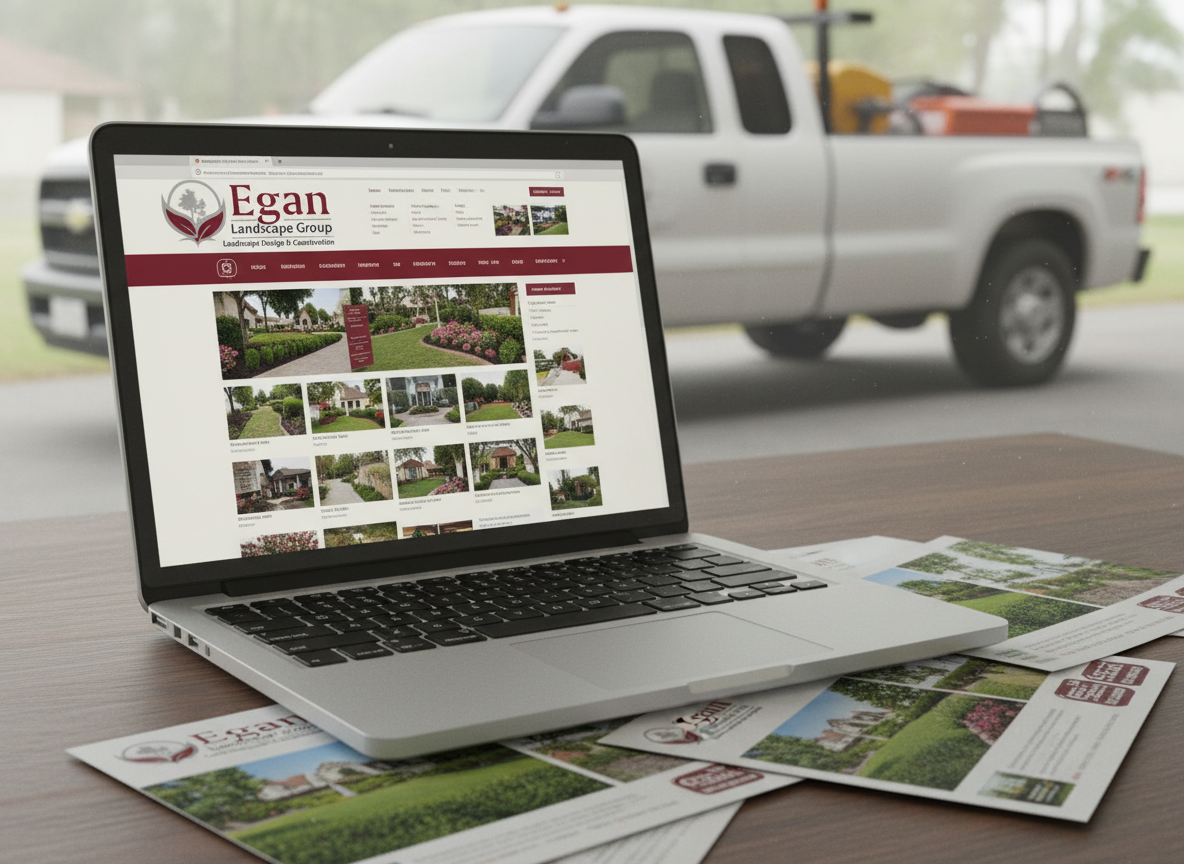
They had hundreds of pictures and videos from 20+ years in business, but nothing that actually worked for ads, their website, or social media. No revenue line-specific funnels. No dedicated landing pages. No way to segment leads by service type. Everything was generic, and it showed.
The Google Ads setup had some significant issues. Here’s what the previous vendor had set up:
-
- Only three campaigns running: A basic Performance Max campaign, a branded search campaign, and a landscape maintenance campaign using broad match keywords only
-
- Zero conversion tracking set up in Google Ads
-
- Campaigns optimized toward “Max Conversions” with no data signals to guide the algorithm
-
- Cost per lead sitting at $125 (based on inflated metrics that counted website visits as conversions)
-
- Poor lead quality: Tire-kickers, wrong service requests, and out-of-area leads
The real issue? The previous vendor was running branded efforts disguised as lead generation. The campaigns were basically taking credit for the brand awareness Egan had already built through 20+ years of offline marketing. The landscape maintenance campaign was showing up for competitor search queries, which meant Egan was paying for clicks from people looking for their competitors.
They weren’t generating new business. They were just intercepting existing demand—and paying Google handsomely for the privilege.
On top of all this, Egan had HubSpot set up but was overthinking it. Leads weren’t being attributed correctly, and there was no clear system for qualifying leads or syncing conversion data back to Google Ads. They had all the tools they needed, but nobody had put them together in a way that actually worked.
The Audit: What I Found
I spent three days auditing Egan’s entire digital presence, and what I uncovered pretty much confirmed everything I suspected. The campaign structure needed a complete rebuild, and the tracking gaps were just as significant.
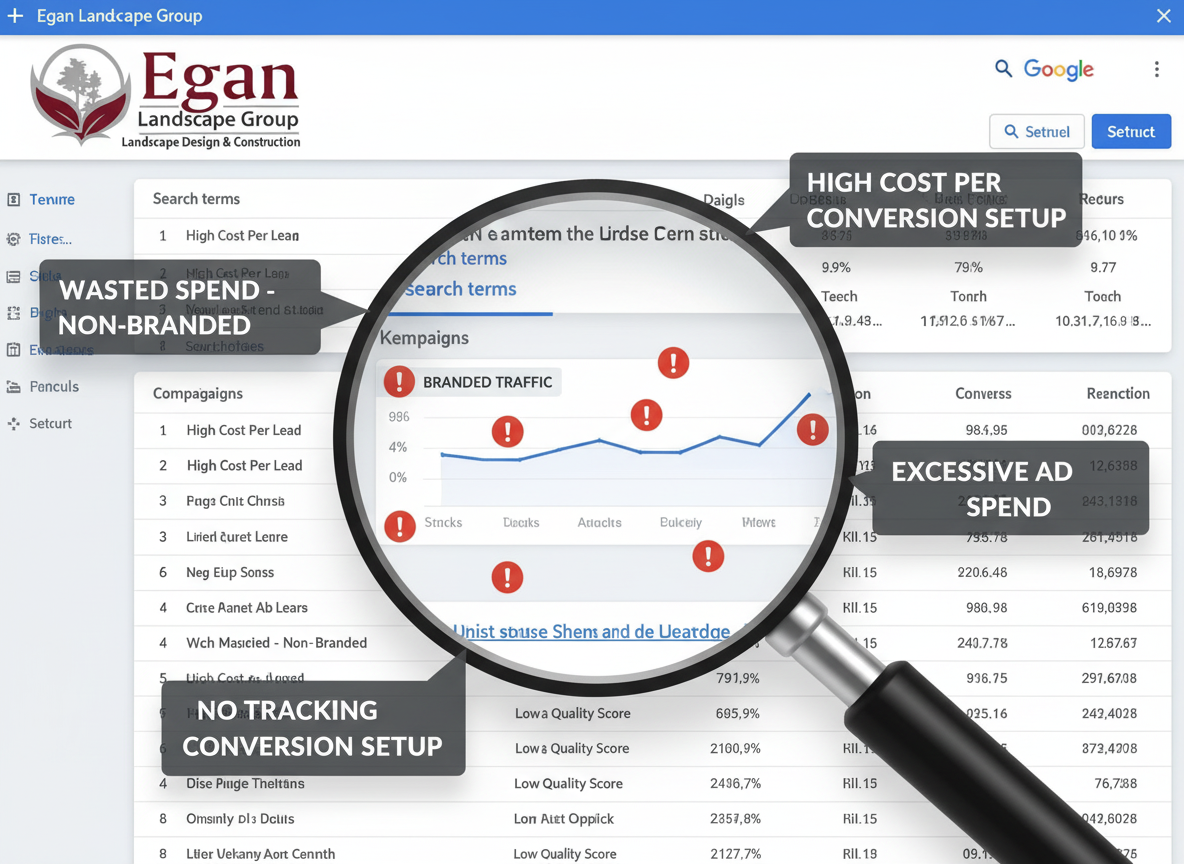
Google Ads Account Issues:
-
- Campaign structure wasn’t optimized for performance
-
- No negative keywords (money wasted on irrelevant searches)
-
- No dedicated landing pages for different services
-
- No conversion events flowing into Google Ads
-
- The algorithm had no idea what a “good lead” looked like
Website & Tracking Gaps:
-
- GA4 was installed but conversion events weren’t connected to Google Ads
-
- No call tracking whatsoever
-
- No way to attribute leads back to specific campaigns or service lines
-
- Multi-touch attribution was completely non-existent
-
- The owner couldn’t update the Squarespace site quickly or easily
-
- Content misrepresented the brand
-
- Hundreds of photos/videos but nothing optimized for ads, website, or social
Missing Infrastructure:
-
- No revenue line-specific funnels
-
- No service-specific landing pages
-
- No way to segment or throttle leads by service type
They were flying blind, making decisions based on gut feel instead of data. But here’s the thing—despite all the challenges, there was a silver lining. Egan had strong brand recognition in the Greater Boston market, a solid service offering, hundreds of visual assets to work with, and they were willing to invest in doing things right. All the pieces were there, they just weren’t being used correctly.
The Strategy: Rebuilding From the Ground Up
After presenting my findings, Egan immediately bought in. They’d been burned before, but they could see that I understood their business and had a clear plan to fix what was broken.
1. Website Migration (Squarespace → WordPress)
First things first—I needed to get Egan off Squarespace and onto a platform that could actually support their growth. I migrated them to WordPress using the Florax gardening and landscape theme, which gave us the flexibility, speed, and control they needed. The migration took about two weeks, then I spent another week and a half going back and forth on revisions to get everything dialed in.
During the migration, I created revenue line-specific funnels with dedicated landing pages—one for residential landscape maintenance and design, and another for commercial landscape maintenance and design. These landing pages were critical because they allowed me to send traffic from specific campaigns to pages that were tailored to what the user was searching for. According to Unbounce’s research, dedicated landing pages convert 65% higher than generic website pages—and I was banking on that lift.
I also optimized their hundreds of photos and videos so they’d actually work for ads, the website, and social media. Great visual assets are useless if they’re not formatted, sized, and positioned correctly.
2. Tracking & Attribution Overhaul
This was the foundation of everything. Without proper tracking, you’re flying blind, and that’s exactly where the previous vendor had left Egan.
What I Implemented:
-
- GA4 (already in place from earlier work)
-
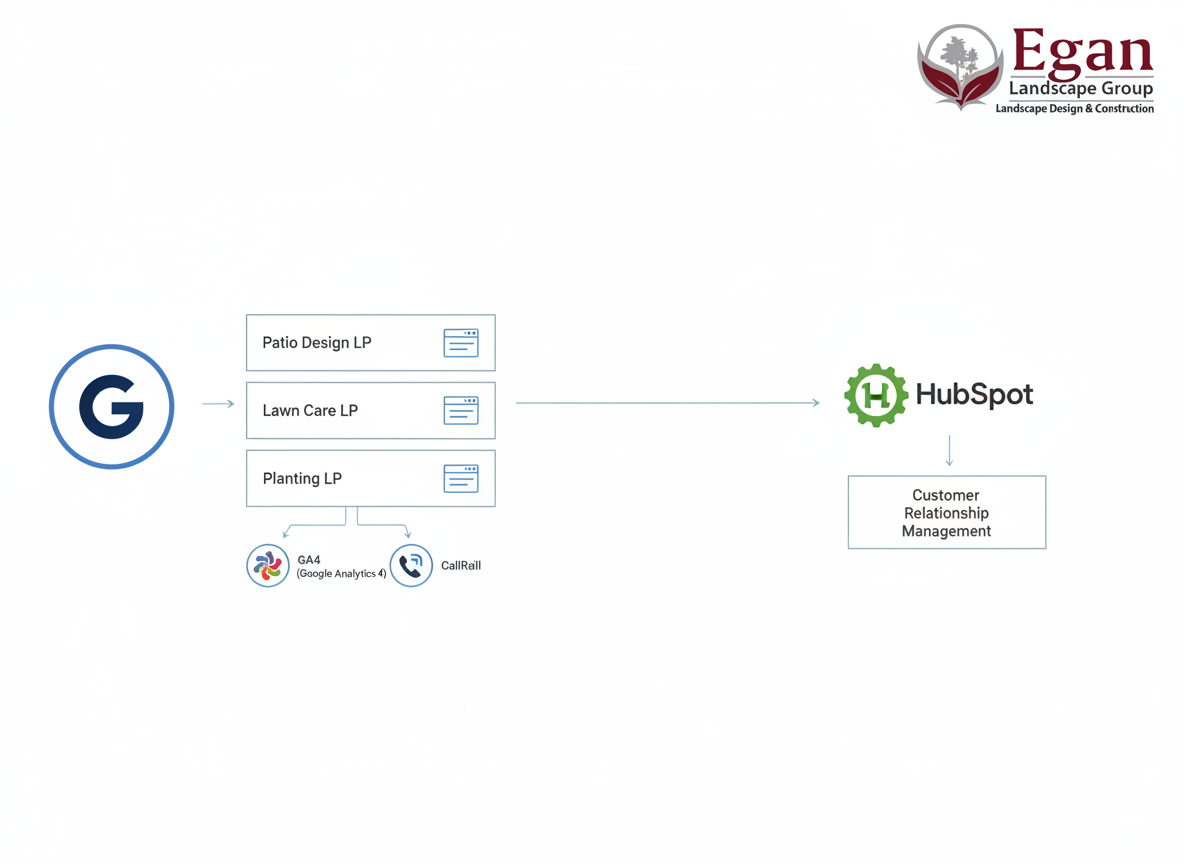
- Tweaked events and conversions and the way they integrated with Google Ads and the GTag
-
- GA4 (already in place from earlier work)
-
- Google Tag Manager for flexible event tracking
-
- CallRail for call tracking and attribution
-
- HubSpot integration with Google Ads (proper field mapping and trigger setup)
What I Tracked:
-
- Form submissions
-
- Click-to-call events
-
- Calls from ads
-
- Time on page
-
- Begin filling form (micro-conversion)
-
- All page views
The game-changer was simplifying the HubSpot lifecycle stages and creating a clear trigger. When a lead status changed to “Send Lead to Jobber” (their scheduling platform), it triggered the lifecycle stage “Opportunity.” This synced back to Google Ads as a Qualified Lead conversion with the GCLID attached. Now Google Ads knew exactly which campaigns, keywords, and ads were driving real business—not just form fills.
The HubSpot integration was non-negotiable. According to HubSpot’s own data, marketers who use HubSpot and Google Ads together average 31% more leads within 90 days of setting up the integration. But more importantly, it gave me the ability to feed qualified lead signals back to the algorithm—which is what separates campaigns that scale from campaigns that burn money.
3. Google Ads Campaign Restructure
I completely rebuilt Egan’s account from scratch. The old structure was beyond saving, so I started fresh.
New Campaign Structure:
-
- Service-specific campaigns: Each service line got its own campaign with a dedicated landing page
-
- Single Keyword Ad Groups (SKAGs): Dedicated keywords per ad group for precise budget control
-
- Dynamic Search Ads campaign: Safety net to catch new intent keywords
-
- Geographic targeting: Focused on zip codes where Egan could comfortably run their trucks
-
- Demographic adjustments: Started wide open (18+), then refined to 25+ based on performance
What I Added:
-
- Negative keyword lists to eliminate waste
-
- Ad copy tailored to each service line
-
- Conversion-optimized landing pages
-
- Smart Bidding with actual conversion data feeding the algorithm
The SKAG approach gave me laser-focused control over budget allocation and ad relevance. Research from CXL shows that single keyword ad groups can increase click-through rates by up to 28% and improve Quality Scores significantly—which directly translates to lower costs and better ad positions.
On the negative keyword front, I was thorough. Industry data from Single Grain shows that proper negative keyword management can reduce wasted spend by an average of 23%. For Egan, that meant protecting their budget from irrelevant searches like “landscape photography,” “landscape architecture degree,” and competitor brand names.
I kept the Google Local Service Ads that the previous vendor had set up, but I optimized the budget and monitoring to make sure they were actually profitable. The timeline for all of this was about a month from audit to launch, with profitability achieved within a few weeks and full optimization with qualified lead signals happening over the next 3-4 months.
The Execution: How I Made It Work
The first month was all about laying the foundation. I migrated the website, implemented the tracking infrastructure, rebuilt the Google Ads campaigns with proper structure, and launched with basic conversion tracking for form fills and calls. It wasn’t perfect yet, but it was already miles ahead of where they’d been.
Months two and three were about data collection and optimization. I monitored performance daily, added negative keywords to control spend, tested ad copy and landing page variations, and refined demographic and geographic targeting. This is where a lot of agencies drop the ball—they set it and forget it. But the reality is that the first few months are critical for teaching the algorithm what you want.
By month four, I was able to integrate the HubSpot qualified lead signals back to Google Ads. Now the algorithm could optimize toward leads that actually converted to opportunities, not just anyone who filled out a form. This prevented the common problem of spam form fills teaching the algorithm to target bad leads, which I’ve seen wreck accounts in the past.
The Breakthrough Moment: When I presented an ROI report comparing my campaigns to the previous vendor’s performance, showing a 35% improvement in ROAS. That’s when everything clicked. They could see the difference between activity and actual results.
The Results: Let’s Talk Numbers
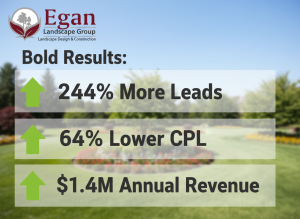
Alright, here’s where it gets fun. Egan’s Google Search Ads performance went from 16 monthly leads at a $125 cost per lead to 55 monthly leads at a $45 cost per lead. That’s a 244% increase in lead volume and a 64% reduction in cost per lead.
To put that $45 CPL in perspective, the average cost per lead for home services on Google Ads is around $90.92 according to recent industry benchmarks. I was operating at half the industry average while generating significantly higher volume. Not too shabby.
Google Search Ads Performance
Before (Previous Vendor): – Monthly Ad Spend: $2,000 – Monthly Leads: 16 – Cost Per Lead: $125 – Lead Quality: Poor (tire-kickers, wrong services)
After (My Work): – Monthly Ad Spend: $2,500 (+25% investment) – Monthly Leads: 55 (+244%) – Cost Per Lead: $45 (-64%) – Lead Quality: Qualified leads by service line (major improvement)
Google Local Service Ads Performance
The Google Local Service Ads were already running when I took over, but I optimized them to perform better:
-
- Monthly Spend: $2,000
-
- Monthly Leads: 39
-
- Cost Per Lead: $53
Combined Performance
-
- Total Monthly Leads: 94
-
- Total Monthly Ad Spend: $4,500
-
- Blended Cost Per Lead: $48
Revenue Impact
Now here’s where it gets really interesting. Egan’s average job value is $8,500, and their close rate is 15%. That means out of 94 monthly leads, they’re closing about 14 jobs per month.
-
- Average Job Value: $8,500
-
- Close Rate: 15%
-
- Monthly Closed Jobs: ~14 (94 leads × 15%)
-
- Monthly Revenue from Campaigns: ~$119,000
-
- Annual Revenue Impact: ~$1,428,000
ROI Calculation
-
- Monthly Ad Spend: $4,500
-
- Monthly Revenue Generated: ~$119,000
-
- Return on Ad Spend (ROAS): 26.4x
-
- Annual Ad Spend: $54,000
-
- Annual Revenue Generated: ~$1,428,000
Even when you factor in my $1,500 monthly retainer ($18,000 annually), the total marketing investment is $72,000 per year generating $1,428,000 in revenue. That’s a 19.8x return on their total marketing investment. Yeah, you read that right.
Beyond the Numbers: What Actually Changed for Egan
The numbers tell part of the story, but they don’t capture everything that changed for this business.
Before Working Together:
-
- Relying on 20+ years of offline brand building
-
- No control over lead volume or service line demand
-
- Wasting money on unqualified leads
-
- No visibility into what was working
-
- Paying to intercept their own brand traffic
After Working Together:
-
- Predictable lead flow by service line
-
- Ability to throttle leads based on crew capacity
-
- Clear attribution showing exactly where revenue comes from
-
- Planning to expand and purchase another location next year
-
- Actually generating new demand, not just capturing existing awareness
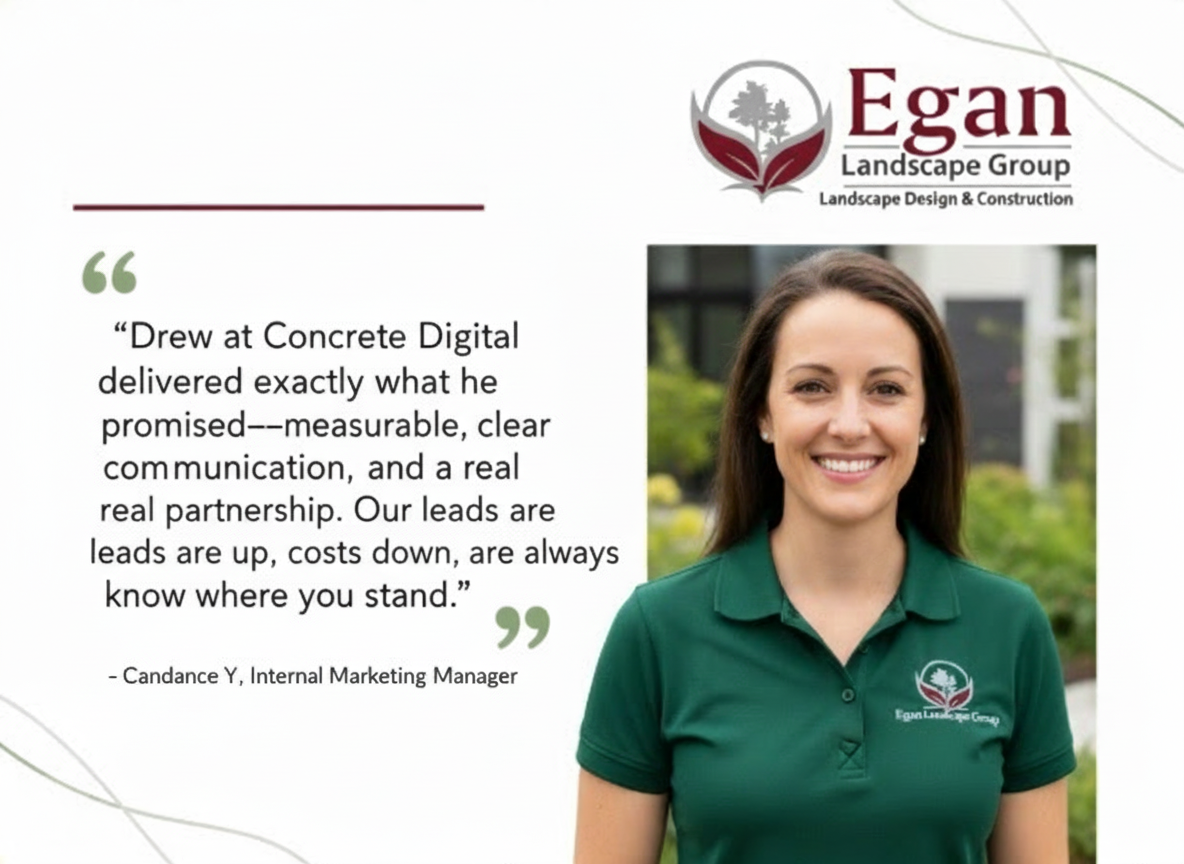
When I asked about the biggest difference between working with me versus their previous vendor, the answer was simple: transparency and communication. I keep it straightforward. I make sure the client knows what’s happening, why it’s happening, and what the results mean for their business. In a world where AI is making the technical side of marketing easier, the customer service portion is what earns and keeps clients.
Lessons & Takeaways
The biggest challenge early on was some pushback about campaign structure and how things work in the digital marketing world. I chalked that up to the bad taste left by previous vendors who didn’t communicate clearly. The solution was patience, education, and proof. Once they saw the ROI report showing a 35% improvement in ROAS, trust was established.
If I Could Do It Over Again
I’d probably have one more discovery call upfront to iron out nuances in the service lines earlier. Understanding the business deeply from day one would have saved me a few weeks of iteration and keyword optimizations.
What Landscape Companies Can Learn From Egan’s Success
There’s a lot of noise in this space. Digital marketing doesn’t happen overnight. There are learnings that need to happen on three fronts:
-
- The person running the ads needs to understand your business and market
-
- The business needs to understand how digital channels work
-
- The platform needs to learn what a good lead looks like
Patience and maintenance are critical. You can’t set it and forget it. Campaigns need daily monitoring, weekly optimizations, and monthly strategic reviews.
The One Thing You Need to Know
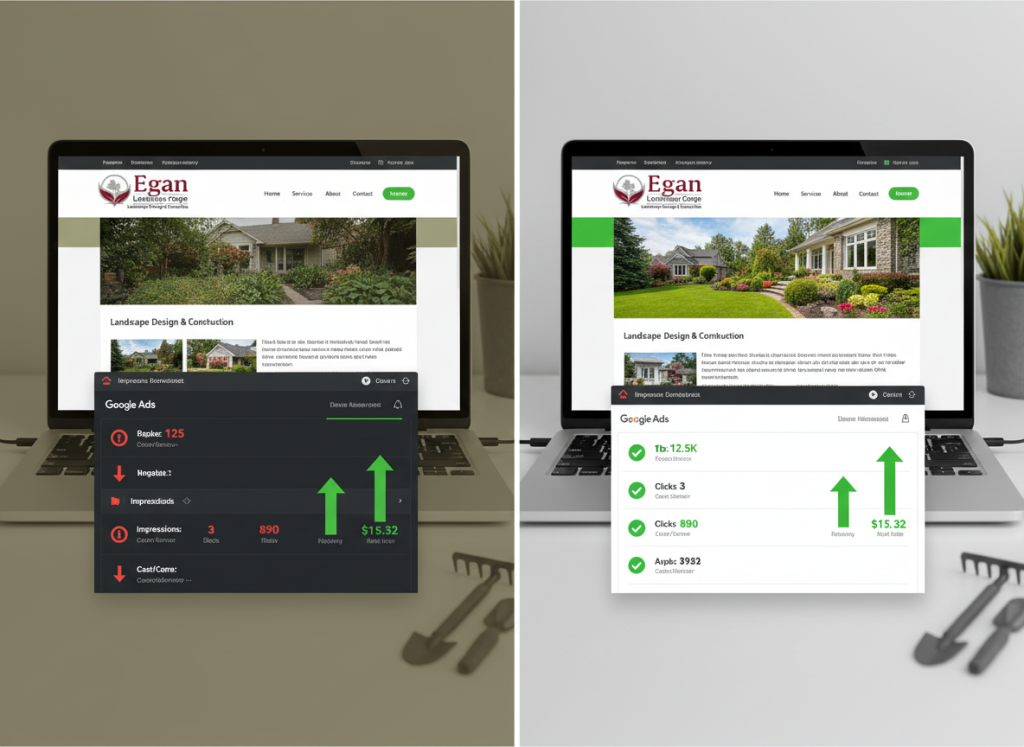
Tracking and attribution can literally make or break you. The Google Ads algorithm is getting smarter, but you have to point it in the right direction. Without proper conversion tracking and qualified lead signals, you’re teaching the algorithm to optimize toward the wrong goal.
The good news? You can make progress quickly.
The bad news? If you’re going the wrong way, you’ll just get there faster.
Egan had been spending $3,000/month for six months with their previous vendor—$18,000 invested with not much to show for it. Within weeks of implementing proper tracking and campaign structure, they were profitable. Within four months, I’d uncovered $1.4 million in hidden annual revenue that was sitting there the whole time. That’s the difference between activity and strategy.
Why This Matters
This case study isn’t just about Egan Landscape Group. It’s about what’s possible when you combine:
-
- Proper tracking and attribution (the foundation)
-
- Strategic campaign structure (not just throwing money at Google)
-
- Qualified lead signals (teaching the algorithm what success looks like)
-
- Transparent communication (keeping the client informed and confident)
If you’re a home service business—landscaping, pool service, painting, HVAC, plumbing, or anything in between—this process works. The platforms are the same. The principles are the same. The results are repeatable.
Ready to Build Your Own Revenue Channel?
If you’re tired of wasting money on Google Ads that don’t deliver, or if you’re working with a vendor who can’t explain where your leads are coming from, let’s talk.
I specialize in turning paid advertising into predictable revenue for home service companies. No contracts. No runaround. Just transparent communication and proven results.
Ready to See Results Like This for Your Business?
Let’s talk through your goals and see what kind of growth we can unlock.
Schedule a Free Consultation →